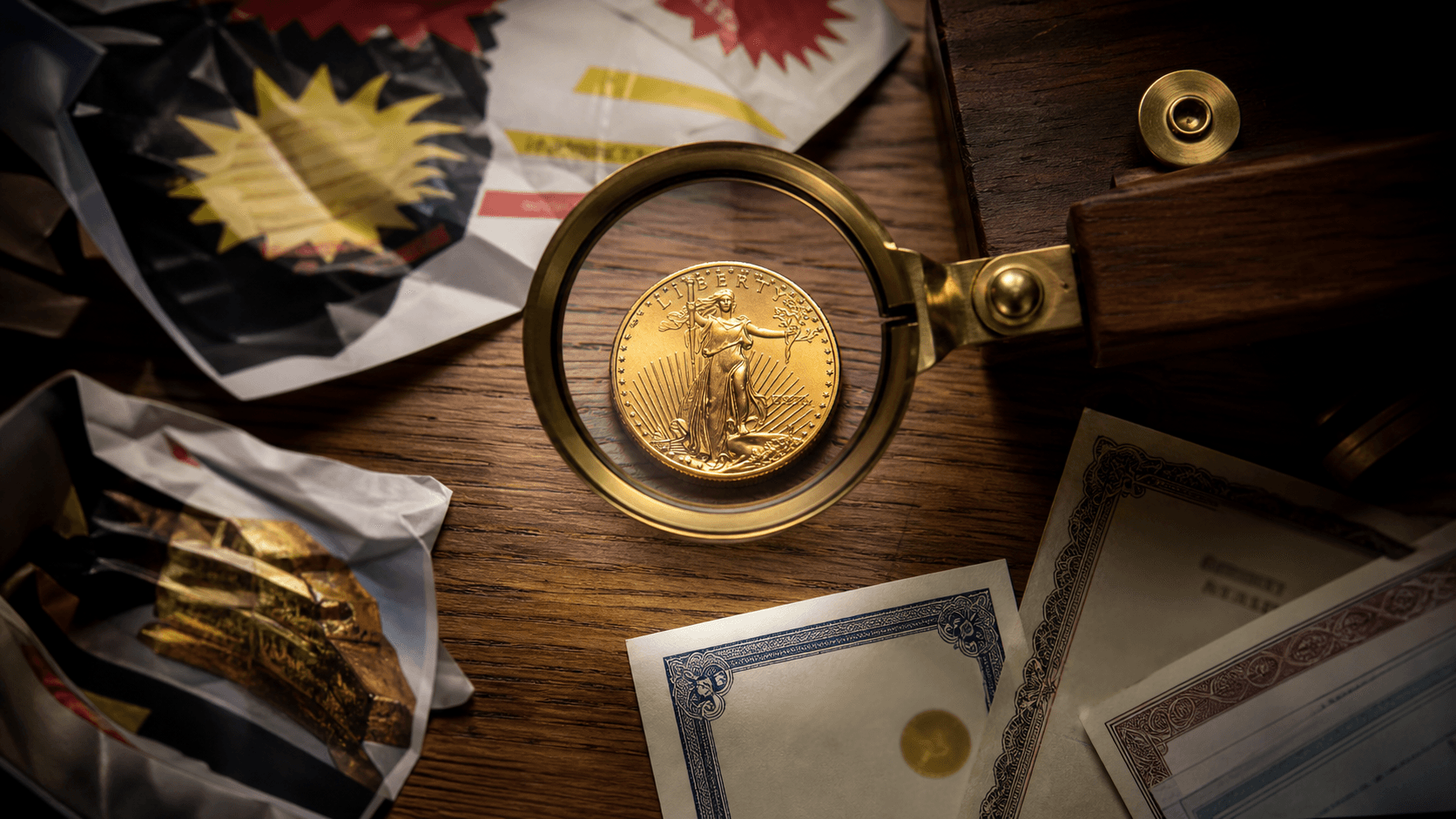
Owners moving outside the banking system to buy physical gold and silver often enter unfamiliar territory. Growing demand for sound money also attracts dishonest sellers who rely on the inexperience of first-time buyers. Two patterns account for most of the difficulty.
Trap one: numismatic coins and inflated premiums
One of the most common practices is to steer a buyer away from standard bullion coins — the Krugerrand, the Vienna Philharmonic — towards rare, collectible or historic numismatic coins, carried at very high premiums on the argument that their value will rise sharply over time.
For an owner buying to preserve purchasing power, that is a different proposition. Investment gold takes its price from the weight and fineness of the metal. Buying for family security means standard bullion products at the lowest available mint premium, rather than paying for a collector’s valuation.
Trap two: offers at or below spot
The exchange price of gold is publicly available. Mining, refining, certification and secure delivery always cost something, which is why physical metal is never cheaper than spot. An offer at or below the current spot price is a reason to end the conversation. In practice it usually indicates a counterfeit — tungsten cores plated with a thin layer of gold are the classic example — or a scheme in which the metal does not physically exist.
The standard to hold to
Buy only from established dealers with a settled market position. Ask for products from mints accredited by the LBMA. That accreditation is a global mark of credibility: it supports the quality and fineness of the metal and makes it straightforward to sell or buy back internationally.
In summary
Protecting the results of a working life is not the place for haste or for chasing an opportunity. Real security rests on knowledge, sound fundamentals and advisers who can be relied upon. Certified metal, held directly or entrusted to a proven vault, carries value that can be verified.